Master Your Business Future with a 3-Year Sales Forecast Template
Running a business without a financial roadmap is like navigating a city without a map. You might eventually get where you're going, but you'll waste time, fuel, and opportunities along the way. That's where a 3-Year Sales Forecast Template becomes invaluable. It's not just a spreadsheet—it's a strategic tool that transforms raw numbers into a clear narrative about where your business is headed over the next thirty-six months.
Think of this template as the backbone of your financial planning. It breaks down your revenue streams by product or service, month by month, for three full years. This level of detail lets you spot seasonal trends, anticipate cash flow dips, and set milestones that actually mean something. Whether you're a startup pitching to investors or an established small business mapping out expansion, having this kind of clarity changes how you make decisions.
Why a 36-Month View Changes Everything
Most businesses plan quarterly or annually. That's fine for survival, but growth requires a longer lens. A 3-Year Sales Forecast Template forces you to think beyond next quarter's targets and consider how today's choices ripple into year two and year three. You start to see patterns—maybe your product sells best in Q4, or perhaps a new service line takes eighteen months to gain real traction. These insights are gold when you're allocating budgets, hiring staff, or negotiating with suppliers.
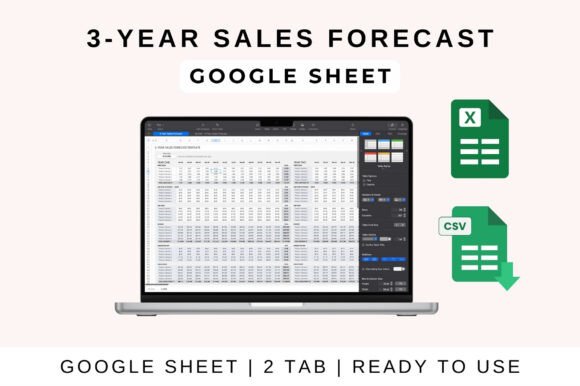
The template itself is built for practicality. You input your products or services, set unit prices, and estimate expected sales volumes. From there, the sheet auto-calculates monthly, quarterly, and yearly totals. No manual math, no formula errors. It's designed to work seamlessly across Google Sheets, Excel, and Apple Numbers, so you're never locked into one platform. That flexibility matters when you're collaborating with a team or presenting to stakeholders who prefer different tools.
Building Your Forecast Step by Step
If you're using Google Sheets, the process is straightforward. Upload the template to your Drive, open it, and start entering your data under the appropriate categories. The built-in formulas handle the rest—totals, profit margins, and loss calculations update instantly as you type. You can customize categories, adjust formulas, and tweak the visuals to match your brand's look. Sharing with your team is just a click away, enabling real-time collaboration that keeps everyone aligned.
For Excel users, download the file, enable editing when prompted, and you're ready to go. The interface feels familiar, and the template's structure guides you through each section logically. Numbers for Mac works just as smoothly, with full compatibility ensuring nothing gets lost in translation between platforms.
From Spreadsheet to Strategy: Making the Template Work for You
A template is only as useful as the thinking behind it. The real value of a 3-Year Sales Forecast Template lies in how you interpret and act on the data it produces. For example, if your forecast shows steady growth in year one but a plateau in year two, that's a signal to innovate—launch a new product, explore a different market, or adjust your pricing strategy. The numbers tell a story; your job is to read it and respond.
This tool is particularly powerful for business plans and investor decks. Investors want to see that you've thought through your revenue model, not just hoped for the best. A detailed, month-by-month projection shows discipline and realism. It tells them you understand your market, your customers, and the financial mechanics of your business. For internal use, it becomes a benchmark—a way to measure actual performance against your projections and course-correct early.
Practical Applications Across Industries
Whether you're running an e-commerce store, a consulting firm, a creative agency, or a local bakery, the principles remain the same. You need to know what you're selling, at what price, and in what volume. The 3-Year Sales Forecast Template adapts to any business model because it focuses on fundamentals rather than industry-specific jargon. You can add rows for multiple product lines, adjust for seasonal fluctuations, or build in assumptions about market growth.
For service-based businesses, the template lets you forecast billable hours or project-based revenue. For product businesses, it handles inventory planning alongside sales projections. The versatility makes it a staple in any entrepreneur's toolkit—a design asset for your financial strategy, much like a premium font is an asset for your visual brand identity.
Tying Financial Clarity to Brand Consistency
There's an interesting parallel between financial planning and brand design. Just as a well-chosen typeface creates visual hierarchy and reinforces brand perception, a solid forecast creates financial hierarchy and reinforces business credibility. Both require consistency, attention to detail, and a clear understanding of your audience. When you present a polished forecast to investors or partners, it communicates professionalism—the same way thoughtful typography does in your marketing materials.
Consider how you might use this template alongside your other business tools. Pair it with your brand guidelines, your marketing calendar, and your operational plans. When financial projections align with creative strategy, you build a business that feels cohesive from every angle. That's the kind of consistency that builds trust with customers, investors, and your own team.
Final Thoughts on Long-Term Planning
Three years might seem like a long horizon, but in business, it arrives faster than you expect. The decisions you make today—pricing, hiring, product development—compound over time. A 3-Year Sales Forecast Template gives you the framework to make those decisions with confidence, grounded in data rather than guesswork. It's not about predicting the future perfectly; it's about preparing for it thoughtfully.
Start with what you know, make reasonable assumptions, and revisit your forecast regularly. Update it as real numbers come in, adjust for market shifts, and use it as a living document that grows with your business. The clarity you gain isn't just financial—it's strategic, operational, and ultimately, empowering. That's the real return on a well-built forecast.