Real Estate Service Website Template: One-Click Publishing
Why a Single-Page Template Changes Everything
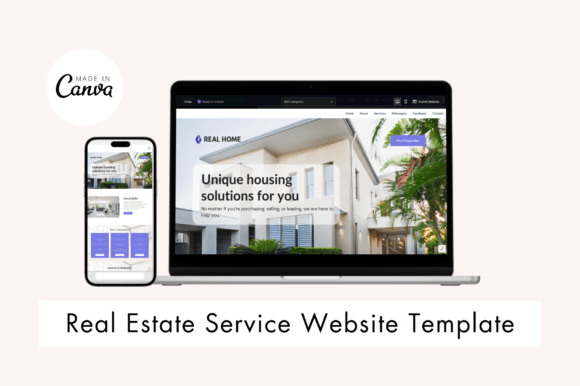
In the fast-paced world of real estate marketing, time is a resource you cannot afford to waste. Whether you are an independent agent, a property manager, or a boutique agency owner, your online presence needs to be established quickly and maintained easily. The Real Estate Service Website Template is not just a design file; it is a strategic tool designed specifically for those who need a professional website without the weeks of back-and-forth with developers. This template utilizes the power of modern web design principles, combining aesthetic appeal with functional efficiency. It offers a single-page professional layout that guides your potential clients through your services, listings, and contact information seamlessly.
The core value of this Canva Real Estate Service Website Template lies in its accessibility. You do not need to understand HTML, CSS, or JavaScript to get your site live. Instead, the template leverages the intuitive drag-and-drop interface of Canva, allowing you to focus on what matters most: your content and your clients. By bridging the gap between design software and web hosting, this solution provides a streamlined path from concept to publication. It is an ideal solution for entrepreneurs and small business owners who require agility in their operations.
Visual Personality and Design Architecture
When evaluating a premium font or a design asset, we often look for a specific "voice." The same applies to this website template. Visually, the design embraces a clean, minimalist aesthetic that is common in high-end property marketing. It avoids clutter, recognizing that in real estate, the photography of the properties must take center stage. The layout uses ample white space to create a sense of luxury and openness, mirroring the feeling of a well-staged home. The typography choices within the template are intentional; typically, these designs pair a bold, clean sans serif font for headers with a highly legible serif or sans serif for body text, ensuring that information is communicated clearly.
The structure of the template is built around a logical flow. It usually begins with a strong hero section—often referred to as "above the fold"—where you can place your agency's name and a striking image of a property. This is followed by sections dedicated to "About Us," "Services," "Featured Listings," and "Contact." This linear journey is perfect for a single-page format, as it prevents users from getting lost in multiple sub-menus. The visual hierarchy is established through the size of the text elements and the strategic placement of call-to-action buttons. For a marketer or brand strategist, this structure is vital because it directs the user’s eye exactly where it needs to go, increasing the likelihood of conversion.
Customization: Tailoring the Template to Your Brand Identity
One of the most frequent questions regarding templates is about flexibility. With this specific Real Estate Service Website Template, customization is the primary feature. The prompt states clearly: What’s Editable? The answer is virtually everything. You have the power to alter Images, Color, Font, Elements, and BG Color. This level of control is essential for maintaining brand consistency.
For instance, if your agency's brand identity relies on deep navy blues and gold accents, you can easily adjust the color palette to match. If your logo utilizes a specific script font or a modern typography style, you can swap out the default text styles to align with your existing assets. This ensures that your website does not look generic; it looks like your website. The ability to resize at any size also means you are not locked into a rigid grid. Whether you want to emphasize a specific block of text or enlarge a photo gallery, the tools are at your disposal.
Furthermore, the template supports a variety of export formats. You can free to download in any format (PNG/SVG/JPG/PDF). While the primary goal is website publishing, having access to these files allows you to repurpose the design. You could turn specific sections of your site into social media graphics or use the layout as a basis for digital brochures. This versatility makes the file a valuable addition to your library of design assets.
The Technical Process: Connecting Your Domain
While the design process is creative, the publishing process is technical but simplified. The instructions note that Canva Pro is required to utilize the domain connection feature. This is a crucial detail for users to understand before they begin. The process involves purchasing the file from Creative Fabrica, receiving the editable link, and opening it directly in Canva.
Once inside the editor, you make all your necessary changes—uploading your headshot, writing your bio, and listing your current properties. The final step involves connecting your custom domain. Canva has introduced a feature that allows users to publish their designs directly to a custom URL. Inside the PDF provided with your purchase, you will find a guide on how to manage the DNS settings to point your domain to your Canva design. This eliminates the need for a separate hosting provider or a content management system like WordPress, which can often be overkill for a simple service landing page. It is a "one-click" publishing model that simplifies the technical barrier to entry.
Practical Applications and Use Cases
Who is this template for? While it is labeled for real estate, the applications are broad. Obviously, a real estate agent looking to launch a quick landing page for a new property development will find this invaluable. However, it is also an excellent resource for designers looking to offer a quick-turnaround service to their clients. Instead of building a site from scratch, a designer can purchase this template, customize it for the client, and deliver a live website in a fraction of the time.
It also serves content creators and bloggers who focus on interior design or architecture. They can use this template to create a portfolio of their work or a landing page for affiliate links related to home decor. The clean aesthetic supports high-quality imagery, which is essential for these niches. For the hobbyist or someone just starting out, it removes the intimidation factor of web development. You don't need to learn a new skill set; you just need to use the tools you likely already know.
Strategic Considerations for Design and Usability
When you begin editing, keep readability at the forefront of your mind. While it might be tempting to use a fancy display font for all your text, remember that your visitors are looking for information. Use the creative font options for headers to grab attention, but stick to a clean typeface for paragraphs. Contrast is also key; ensure your text color stands out clearly against the background color you choose.
Consider the user experience on mobile devices. Since Canva websites are responsive, the layout will adjust automatically, but you should still preview how your images crop on smaller screens. Ensure that your "Contact" button is prominent. In the real estate industry, generating a lead is the primary goal of the website, so the call-to-action must be impossible to miss. By treating this template not just as a decoration but as a business tool, you can maximize its effectiveness. This approach aligns with Google Helpful Content guidelines, prioritizing user needs over mere aesthetics.